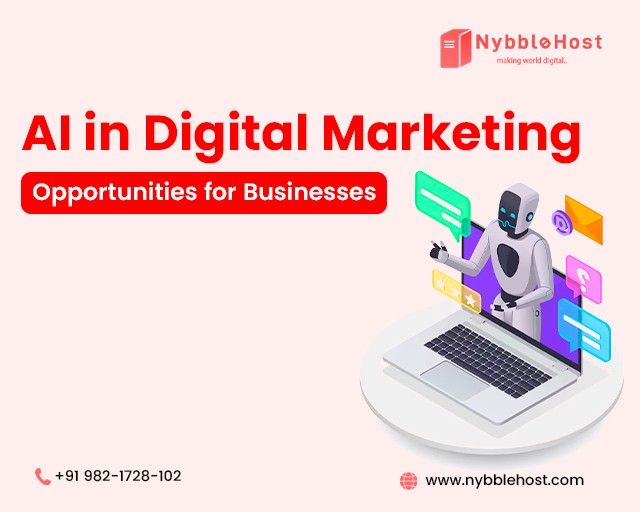
Artificial intelligence is no longer a futuristic concept reserved for tech giants. Today, businesses of every size are using AI in digital marketing to run smarter campaigns, reach the right audiences, and do more with leaner budgets. If you’re still relying solely on manual processes and gut instinct, you’re already playing catch-up.
This guide breaks down exactly how AI is reshaping digital marketing — the real opportunities, practical tools, common pitfalls, and what to expect next.
1. What Does AI in Digital Marketing Actually Mean?
At its core, artificial intelligence in marketing refers to using machine learning, natural language processing, and predictive analytics to automate decisions, personalise experiences, and uncover insights that humans alone would miss.
It’s not about replacing marketers. It’s about giving them sharper tools.
Whether it’s a chatbot handling customer enquiries at midnight, an algorithm deciding which ad to show which user, or a content tool drafting 50 product descriptions in minutes — AI is quietly embedded in nearly every corner of modern marketing.
2. How AI Is Transforming Digital Marketing Right Now
Hyper-Personalisation at Scale
Traditional personalisation meant using a customer’s first name in an email. AI goes far deeper. It analyses browsing behaviour, purchase history, location, device type, and dozens of other signals to serve content, product recommendations, and offers that feel individually crafted.
Amazon’s recommendation engine — responsible for roughly 35% of its revenue — is a well-known example. The same logic now powers email platforms, e-commerce sites, and social media feeds used by mid-size businesses worldwide.
Predictive Analytics and Smarter Decision-Making
Instead of reacting to what happened last month, AI helps marketers predict what’s likely to happen next. Predictive lead scoring, for instance, ranks prospects based on their likelihood to convert — so sales teams focus energy where it counts most.
A B2B SaaS company that shifted from manual lead qualification to AI-driven scoring saw its sales team’s conversion rate improve significantly simply because they stopped chasing cold leads.
Programmatic Advertising
AI-powered programmatic advertising automates media buying in real time. Rather than negotiating ad placements manually, algorithms bid on ad inventory milliseconds before a webpage loads — targeting the right person, at the right moment, at the right price.
This has dramatically improved return on ad spend for performance-focused campaigns.
Conversational AI and Customer Experience
From WhatsApp chatbots to intelligent live chat widgets, conversational AI handles routine customer queries instantly, qualifies leads 24/7, and frees human teams for complex interactions. Businesses that deploy well-trained chatbots report measurable drops in cost per interaction alongside improvements in response time.
3. Key Benefits of AI in Digital Marketing for Businesses
Understanding how AI is transforming digital marketing is one thing. Knowing what it means for your bottom line is another. Here are the most tangible benefits:
- Efficiency gains — Repetitive tasks like A/B testing, report generation, ad optimisation, and email segmentation can be automated, freeing teams to focus on strategy.
- Better audience targeting — AI processes vast data sets to identify micro-audiences that would be impossible to pinpoint manually.
- Improved ROI — Campaigns optimised by AI typically waste less budget on the wrong audiences and placements.
- Faster content production — AI writing assistants accelerate first-draft creation for blogs, ads, product descriptions, and social content.
- Smarter SEO — AI tools now assist with keyword clustering, content gap analysis, and search intent mapping — critical for ranking in a knowledge-graph-driven search environment.
- Real-time responsiveness — Algorithms can pause underperforming ads, reallocate budget, and adjust bidding strategies without human intervention.
One Honest Drawback to Acknowledge
AI is only as good as the data it’s trained on. Biased or incomplete data produces biased outputs. Businesses that rush into AI adoption without a solid data strategy often find themselves optimising in the wrong direction. Human oversight remains non-negotiable.
4. Best AI Marketing Tools Worth Using in 2026
The market is crowded, but these categories consistently deliver real value:
Content and Copywriting Tools in this space generate ad copy, email subject lines, landing page content, and blog drafts. The best ones allow marketers to fine-tune tone, brand voice, and messaging constraints.
SEO and Search Intelligence AI-powered SEO platforms help identify keyword opportunities, analyse competitor content, map semantic relationships between topics, and flag technical issues — all faster than legacy tools.
Paid Advertising Optimisation Google’s Performance Max campaigns and Meta’s Advantage+ suite both use AI to automate audience targeting, creative selection, and bid management. Third-party tools add an additional layer of control and transparency.
CRM and Marketing Automation Platforms with AI-driven lead scoring, predictive send-time optimisation, and behavioural trigger automation make email and CRM workflows significantly more effective.
Analytics and Attribution AI-assisted attribution models give a clearer picture of which touchpoints actually drive conversions — particularly valuable as third-party cookies continue to phase out.
Pro tip: Don’t adopt tools in isolation. The businesses seeing the best results build an integrated stack where data flows between platforms, allowing AI to work with a complete picture rather than siloed fragments.
5. Common Mistakes Businesses Make with AI Marketing
Adoption is growing fast — but so are the missteps. Watch out for these:
1. Automating without a strategy Plugging in an AI tool without defining goals, KPIs, or audience personas is like buying a GPS and not entering a destination. The technology needs direction.
2. Over-relying on AI-generated content AI-written content still needs a human editorial pass. Search engines are increasingly sophisticated at rewarding depth, original perspective, and genuine expertise — things AI drafts often lack without human input.
3. Ignoring data quality Garbage in, garbage out. If your CRM is full of outdated contacts, or your tracking is misconfigured, AI tools will optimise based on flawed signals.
4. Neglecting brand voice Automated content at scale can flatten a brand’s personality. Setting clear style guidelines and reviewing outputs consistently keeps things on-brand.
5. Skipping the compliance checks AI-powered personalisation must operate within GDPR, CCPA, and evolving data privacy regulations. Marketing teams need legal and compliance alignment before deploying customer-data-driven AI.
6. Pro Tips: Getting the Most Out of AI in Your Marketing Stack
- Start with one use case — Don’t overhaul everything at once. Pick the highest-friction area (say, lead qualification or ad creative testing) and prove value there first.
- Train your team — AI tools are only powerful in the hands of people who understand how to prompt, interpret, and challenge the outputs.
- Build feedback loops — Regularly review what the AI is doing and why. Most platforms offer explainability features that help marketers course-correct.
- Use AI for research, not just production — Competitive analysis, audience insight extraction, and search intent mapping are areas where AI adds enormous value that’s often overlooked.
- Document your prompts and workflows — If a particular approach consistently produces great results, systematise it so the whole team benefits.
7. AI Marketing Trends 2026 and Beyond
AI marketing trends 2026 point toward several significant developments:
Multimodal AI in creative production — AI tools that generate and analyse text, image, video, and audio together are enabling smaller teams to produce campaign assets at a scale previously reserved for large agencies.
AI-powered search and zero-click experiences — As search engines serve AI-generated summaries, businesses need to optimise for featured snippets, structured data, and knowledge graph presence — not just traditional blue links.
First-party data strategies — With third-party tracking continuing to erode, AI tools that extract more value from consented first-party data are becoming central to digital strategy.
Voice and conversational commerce — AI-driven voice interfaces and chat-based purchasing flows are expanding, particularly in mobile-first markets.
AI governance and ethical marketing — Businesses that proactively establish responsible AI use policies — especially around targeting, personalisation, and content authenticity — will build stronger long-term brand trust.
Looking for best digital marketing services in india contact nybble host now
8. Conclusion: Where Businesses Should Focus Now
AI in digital marketing isn’t a trend to monitor from the sidelines. It’s an operational shift that’s already separating high-performing businesses from those falling behind. The opportunity isn’t about having the most sophisticated technology — it’s about applying the right tools intelligently, backed by a clear strategy and quality data.
Start with the areas where you feel the most friction: lead generation, ad performance, content output, or customer retention. Build from there with a clear framework, measurable goals, and a team that understands both the potential and the limits of what AI can do.
The businesses that will thrive aren’t those that hand everything over to algorithms. They’re the ones that combine human creativity and strategic thinking with AI’s speed and analytical power.
FAQs
Q1: What is AI in digital marketing, and how does it work? AI in digital marketing refers to using machine learning algorithms, predictive analytics, and natural language processing to automate tasks, personalise customer experiences, and optimise campaign performance. It works by analysing large data sets to identify patterns, make predictions, and take actions — such as adjusting bids, personalising email content, or ranking leads — faster and more accurately than manual processes allow.
Q2: What are the biggest benefits of AI in digital marketing for small businesses? For small businesses, the primary benefits include cost efficiency (doing more with a smaller team), better audience targeting through data-driven segmentation, faster content creation, and smarter ad spend. AI tools have become increasingly accessible and affordable, making enterprise-level capabilities available to businesses of any size.
Q3: Which AI marketing tools are most effective in 2026? The most effective tools depend on your goals, but high-value categories include AI-powered SEO platforms, programmatic ad optimisation tools, marketing automation systems with predictive lead scoring, and AI writing assistants. The key is integration — tools that share data across your stack consistently outperform siloed solutions.
Q4: Will AI replace digital marketing professionals? No — but it will change what those professionals spend their time on. Routine, repetitive tasks will increasingly be automated, while strategy, creative direction, relationship management, and ethical oversight will become more central to the marketer’s role. The most valuable marketing professionals in 2026 are those who know how to work with AI tools effectively, not instead of them.
Q5: How can businesses start using AI in their digital marketing without a large budget? Start small and focused. Identify one high-impact area — for example, email personalisation, ad copy testing, or chatbot deployment — and use a purpose-built tool to address it. Many platforms offer free tiers or low-cost entry plans. Once you can demonstrate ROI from that initial application, expanding your AI marketing stack becomes much easier to justify internally.