If you’ve ever stared at your social media dashboard wondering why your beautifully crafted post got twelve likes while a competitor’s ad seems to be everywhere, you’re not alone. This is one of the most common questions we hear from business owners: should you invest in organic social media marketing, pour money into paid social media marketing, or try to balance both?
The honest answer is that there’s no universal formula. But there is a smart way to think about it, and that’s what this guide will walk you through.
By the end, you’ll understand exactly how organic vs paid social media stacks up, when each approach makes sense, and how to build a digital marketing strategy that doesn’t waste your budget or your time.
What Is Organic Social Media?
Organic social media refers to the free content you post on platforms like Instagram, Facebook, LinkedIn, TikTok, and X (Twitter) without paying to boost or promote it. This includes your regular posts, stories, reels, and community replies.
Its reach depends entirely on your organic reach, meaning how the platform’s algorithm chooses to distribute your content to followers and potential new audiences. No spend is involved, but the trade-off is patience. Building a genuine following through organic content typically takes months, sometimes years, of consistent effort.
We’ve worked with brands that spent over a year publishing consistent, high-quality content before seeing meaningful traction. That’s not a flaw in the strategy. It’s simply how trust-building works on social platforms.
What Is Paid Social Media?
Paid social media, on the other hand, involves spending money to place your content in front of a specific audience through Meta Ads, Instagram Ads, LinkedIn Ads, TikTok Ads, or X (Twitter) Ads.
This is where PPC advertising and social media advertising come into play. You set a budget and define your target audience, and the platform delivers your content, whether that’s a sponsored post or a boosted post, directly into relevant feeds.
The biggest advantage here is speed. While organic growth can feel slow, paid campaigns can generate visibility, traffic, and even sales within hours of going live.
Organic Social Media vs Paid Social Media: Key Differences
Understanding the practical differences helps clarify which approach fits your current business stage.
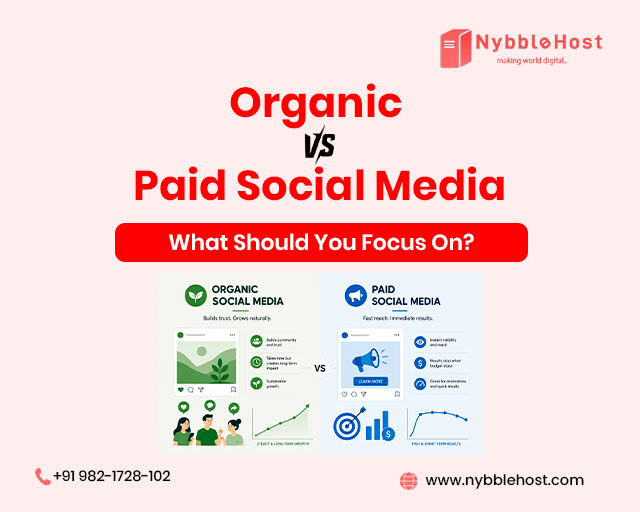
| Factor | Organic Social Media | Paid Social Media |
|---|---|---|
| Cost | Free (time investment only) | Requires ad spend |
| Speed of results | Slow, builds over time | Fast, often immediate |
| Reach | Limited by algorithm | Scalable and targetable |
| Trust building | Strong, feels authentic | Moderate, feels promotional |
| Measurability | Harder to track precisely | Highly measurable (CTR, CPA, CPC) |
| Longevity | Compounds over time | Stops when budget stops |
Both approaches feed into your broader marketing funnel, but they play different roles. Organic content nurtures relationships. Paid content accelerates action.
Benefits of Organic Social Media
Organic content isn’t just a “free” alternative to ads. It plays a specific role that paid campaigns simply can’t replicate.
- Builds authentic brand awareness — audiences trust content that doesn’t feel like a sales pitch
- Strengthens audience engagement — comments, shares, and saves create a real community
- Supports long-term content marketing — a strong post can keep generating value for years
- Costs nothing upfront — ideal for businesses with limited budgets
- Improves social proof — genuine engagement signals credibility to new visitors
The catch is consistency. A single viral post won’t build a brand. It’s the compounding effect of showing up regularly that makes organic strategy work.
Benefits of Paid Social Media
Paid social media earns its place in a paid vs organic social strategy because it solves problems organic content can’t solve quickly.
- Precise audience targeting — reach people by age, interests, behavior, or location
- Fast lead generation — ideal for time-sensitive offers or product launches
- Scalable results — increase budget to increase reach almost instantly
- Clear ROI tracking — metrics like cost per click (CPC), cost per acquisition (CPA), and conversion rate show exactly what’s working
- Retargeting capability — reconnect with people who already showed interest
For a business launching a new product or entering a competitive market, paid social media can compress months of organic growth into a matter of weeks.
Organic or Paid Social Media: When Should You Use Each?
This is where most businesses get stuck. Here’s a practical way to decide.
Choose organic social media when:
- You’re building brand identity and voice
- Your budget is limited or non-existent
- You’re focused on community and customer relationships
- You have time to invest in consistent content creation
Choose paid social media when:
- You need fast customer acquisition
- You’re launching a new product or service
- You want to retarget website visitors
- You need measurable, trackable social media performance
Most established brands don’t pick one over the other. They use organic content to build trust and paid campaigns to accelerate specific business goals, like sign-ups, purchases, or downloads.
How to Combine Organic and Paid Social Media
The strongest social media strategy doesn’t treat organic and paid as competitors. It treats them as partners.
- Use organic content to test messaging. Post a few variations and see what resonates before spending on ads.
- Boost your best-performing organic posts. If a post is already getting strong engagement, paid promotion amplifies proven content instead of gambling on something new.
- Retarget organic engagers with paid ads. People who commented or watched your video are warmer leads than cold audiences.
- Use paid ads to grow your organic audience. Run a campaign specifically to gain followers who’ll see your future organic content.
- Track everything together. Look at your overall social media ROI, not just organic or paid numbers in isolation.
This hybrid approach tends to outperform either strategy used alone, particularly for businesses trying to balance brand building with lead generation.
Common Mistakes Businesses Make
- Treating paid ads as a fix for weak content. Boosting a poorly designed post just means more people see something that doesn’t convert.
- Ignoring organic community management. Paid traffic that lands on an inactive or unresponsive profile loses trust fast.
- Setting vague campaign goals. “Get more followers” isn’t measurable. “Generate 50 leads at under ₹500 CPA” is.
- Not testing before scaling. Pouring your full marketing budget into an untested ad set is a costly gamble.
- Abandoning organic once paid ads start working. Organic content still drives long-term trust and lowers overall acquisition costs.
Pro Tips for a Balanced Social Media Strategy
- Allocate roughly 70% of your effort to organic content and 30% to paid campaigns if you’re early-stage, then adjust based on results.
- Always A/B test ad creatives; small changes in visuals or copy can shift engagement rate significantly.
- Use organic social media campaigns as market research before committing ad spend.
- Track ad impressions alongside actual conversions, not just visibility metrics alone.
- Revisit your strategy quarterly. Platform algorithms and audience behavior shift constantly.
Future Trends in Social Media Marketing
Short-form video continues to dominate organic reach across platforms, while AI-driven ad targeting is making paid campaigns more precise than ever. Expect platforms to keep blurring the line between the two, with features like shoppable posts and algorithm-boosted “organic-style” ads becoming more common.
Businesses that stay adaptable, testing new formats and reallocating budget based on real performance data, will consistently outperform those sticking rigidly to one approach.
Final Thoughts
There’s no single winner in the organic vs paid social media marketing debate. Organic builds the foundation of trust and brand identity. Paid accelerates visibility and results when timing matters.
The businesses that grow fastest and most sustainably are the ones that use both strategically, letting organic content build the relationship and paid campaigns drive the action.
FAQs
1. Is organic or paid social media better for small businesses? It depends on the goal. Organic is better for building trust and brand voice on a limited budget. Paid is better when a small business needs fast leads or sales, especially during launches or promotions.
2. How much should I spend on paid social media? There’s no fixed number. Start small, often 5–10% of your overall marketing budget, test performance, and scale up once you see a consistent, positive return.
3. Can organic social media alone grow a business? Yes, but it requires patience and consistency. Many brands grow purely through organic content, though the process is typically slower than combining it with paid campaigns.
4. What’s the difference between organic reach and paid reach? Organic reach is the number of people who see your content without paid promotion, determined by the platform’s algorithm. Paid reach is the audience your content reaches because you’ve paid to display it to specific targeted users.
5. Should every business use both organic and paid social media? Not necessarily right away, but most businesses eventually benefit from combining both. Organic builds long-term trust while paid social media provides scalable, measurable growth when needed.
If your team is juggling content creation, ad management, and everything in between, it might be time for outside support. As a digital marketing company that’s been in the trenches since 2012, we’ve helped businesses figure out exactly where organic and paid social media fit into their broader growth plan, alongside SEO, website development, and performance marketing. If you’re not sure where to start, we’re happy to take a look at what you’re doing now and point you in the right direction. Contact us today Nybble Host